Independent project
Carbon Credits & Corporate Strategy: A Multi-Case Study
Harvard Kennedy School Of Government
Project Title: Financial and Economic Impacts of Carbon Credit Trading on Businesses
Mentor: Professor Soroush Saghafian ,Associate Professor of Public Policy, HKS
Overview: Examined how carbon credit trading influences corporate strategy and financial outcomes across multiple industries. The study contrasts compliance regimes (e.g., the EU Emissions Trading System) with voluntary markets where firms buy offsets toward net-zero targets, revealing how market design and policy architecture steer corporate climate action.
Method Employed:
-
Multi-case design with executive interviews and firm-level strategy analysis.
-
Cross-industry comparison of manufacturers, services, and tech firms.
-
Focus on decision pathways: reduce, purchase, or trade credits.
Key Findings:
-
Companies balance emissions-cost exposure with opportunities to reduce or trade credits.
-
Common tools include internal carbon pricing, financial hedging, and rigorous offset selection to manage risk.
-
These choices materially affect profitability and, in some cases, credit ratings.
-
Clear sectoral patterns: manufacturers prioritise real emissions cuts; service and tech firms lean into carbon-neutral branding and high-quality offsets.
Importance of the project: The project demonstrates how the rules and incentives of carbon markets directly influence corporate behaviour, linking sustainable finance mechanisms to measurable strategic and financial outcomes and deepens my focus on market-driven climate solutions.
_edited.jpg)
UCSC SIP LIT-03: How to Survive the End of the World: Applied Research and Creative Writing
Erosion of Political Subtext in Cinema Adaptations – Researched how political literature changes when adapted into film, focusing on HBO’s Fahrenheit 451 (2018) and Halas & Batchelor’s Animal Farm (1954). Through comparative analysis, I examined how cinematic constraints, commercial pressures, and ideological reframing diluted the original texts’ critiques of American paranoia. Highlighted the role of Cold War censorship and post-9/11 anxieties in shaping adaptation choices. Concluded that adaptation is never neutral but carries cultural and political implications.
Skills Developed :
Literary and film analysis (close reading, thematic fidelity, character integrity, symbolism).Historical contextualisation (Cold War propaganda, McCarthyism, post-9/11 surveillance culture).Critical writing with scholarly sources and case study methodology.
Outcomes
-
Demonstrated how adaptations reshape or erase political critique to align with cultural norms.
-
Produced a 10-page academic paper linking literature, film, and political history.
Impact
-
Showed that adaptation is an ideological act, not just a creative one.
-
Contributed to understanding how media reframes political ideas for audiences.
-
Strengthened ability to connect cultural products with broader political and historical contexts.


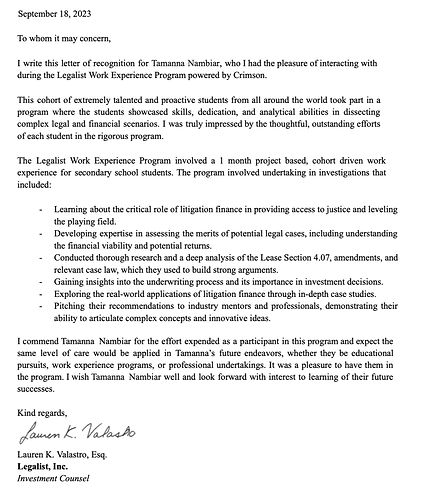
The Legalist Work Experience Program involved a 1-month project-based, cohort-driven work
experience for secondary school students.
-
Researched litigation finance and its role in access to justice.
-
Assessed case merits, financial viability, and relevant case law (Lease Section 4.07).
-
Gained exposure to underwriting, applied insights through case studies, and pitched recommendations to industry mentors.